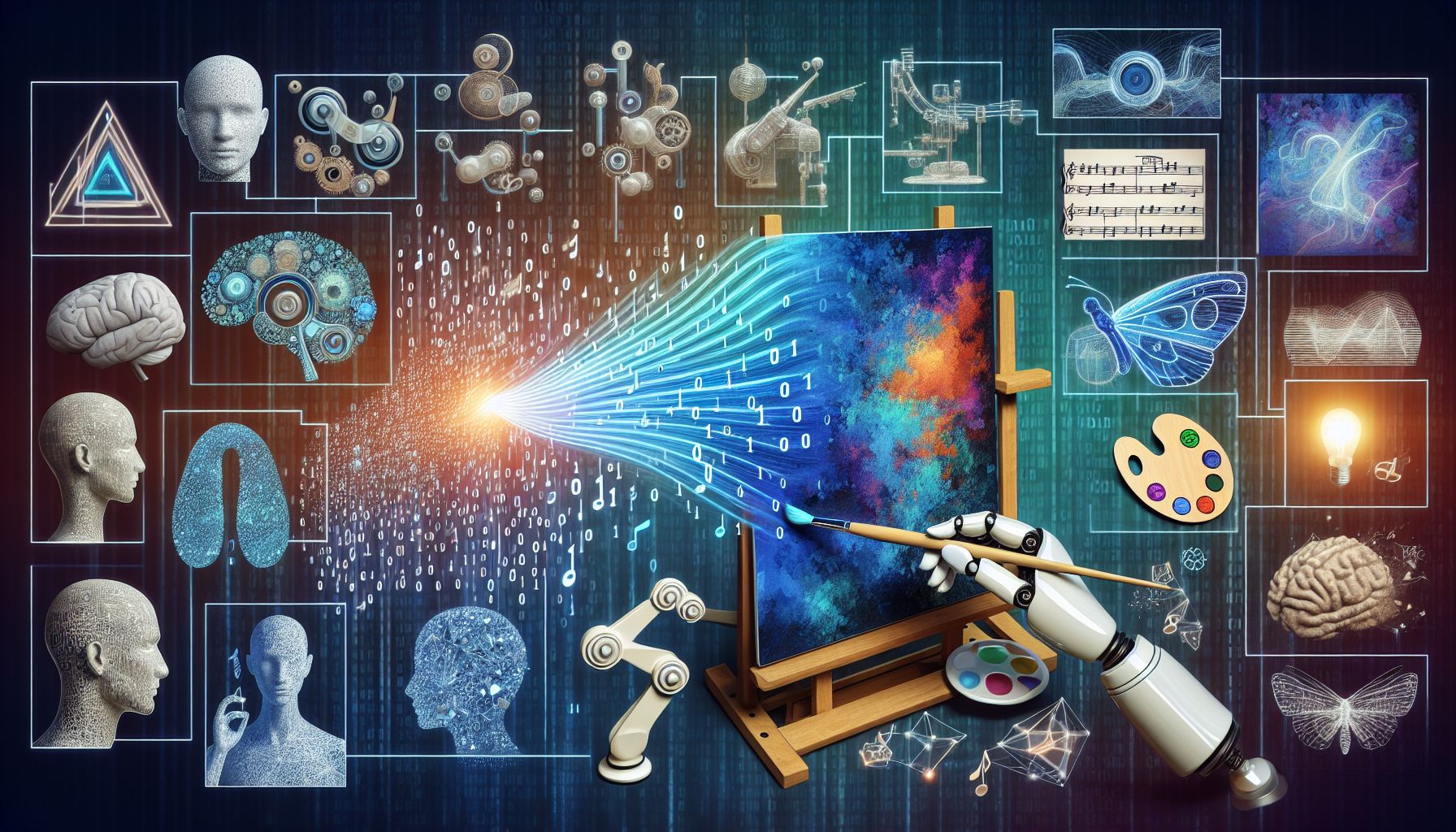
From Bytes to Brushes: The Revolution of AI in Creative Arts 🎨🤖
Hey, tech and art enthusiasts! Today, let’s dig into a topic that’s been making waves like crypto in its heyday but with more colorful results and interesting outcomes—Artificial Intelligence in the creative arts. We’re going beyond the usual tech talk here, exploring new ground where computer minds don’t just think about Picasso but maybe create their own Picassos!
The Brushstrokes of 1s and 0s
Now, if you’re thinking, “Wait, AI in creative arts? Isn’t it just about writing boring financial reports?”, you’d be happily mistaken. AI has put on a beret and picked up a paintbrush, folks! We’re watching both artists and viewers go on a trip through computer-generated imagination. Think digital Da Vinci! The big players pushing these boundaries—OpenAI, Google’s DeepDream, you know the crowd—are already cooking up some pretty wild stuff.
From Paint and Canvas to Neural Nets
Picture this: your standard computer processing paint palettes and canvas into pixels, run through a deep learning algorithm with access to databases bigger than any library, and boom—you’ve got a robot wizard creating modern art! This meeting of computer and canvas raises the question, “Can machines be truly creative, or are they just really good copycats?” Ask artists like Mario Klingemann or check out game changers like DeepArt, and you might find yourself in a philosophical debate where the lines get blurry fast.
AI-generated music? AI poetry? It’s happening right now as you read this. Google’s AI music experiments show that software can dream big, quite literally. Though I have to say, early AI-created tunes had a sleepy quality that wouldn’t exactly pack concert halls.
Artistic Liberation or Threat to Creativity?
Like most new tech, not everyone’s rushing to embrace AI art. There’s some real concern mixed in with the excitement. Critics wonder: are human artists becoming obsolete? After all, pressing a button to instantly produce a Banksy-style piece seems to skip over the years of training and practice that real artists put in.
Let’s Talk Money and Reality
But look past the money concerns to a more interesting possibility—AI as creative partners, not replacements. I can imagine a future where artists use AI to expand their capabilities rather than compete with it. Take illustrator professionals who are already using AI to boost their productivity, seeing their creative visions come to life faster than ever before.
The collaboration between human creativity and machine processing power opens up possibilities we’re just starting to understand. Artists can experiment with styles and techniques that would take months to master manually.
What’s Next: The Creative Horizon
Looking ahead, I see a world where AI becomes another tool in the artist’s toolkit, like Photoshop was for digital artists twenty years ago. The technology will get better at understanding context and emotion, making the results more sophisticated and nuanced.
Getting the Best Results
Right now, the key is learning how to work with these AI systems effectively. The artists who figure out how to blend their human intuition with AI capabilities are the ones creating the most compelling work. It’s not about replacement—it’s about augmentation.
The creative industry is adapting faster than many expected. We’re seeing new roles emerge: AI art directors, prompt engineers, and hybrid artists who specialize in human-machine collaboration. The economics are shifting too, with some AI-generated pieces selling for serious money at auction houses.
But there are real challenges. Copyright questions, authenticity debates, and concerns about devaluing human creativity aren’t going away anytime soon. The art world is still figuring out how to handle these issues.
What excites me most is the democratization aspect. AI tools are making certain types of art creation accessible to people who never had traditional training. That’s expanding the pool of creators in ways we haven’t seen before.
Where We Stand
The truth is, we’re still in the early stages of this technological shift. The tools are improving rapidly, but we’re also discovering their limitations. Some things AI does brilliantly, others still require that human touch.
What I find most interesting is how this technology is forcing us to reconsider what creativity actually means. Is it the final product that matters, or the intention and emotion behind it? These aren’t just technical questions—they’re philosophical ones that will shape how we think about art in the digital age.
The artists who are thriving in this new landscape aren’t fighting the technology—they’re learning to dance with it. And honestly, some of the results are pretty amazing.
Related: Welcome to the Age of AI-Powered Art