When Colors Sing: How Music and Visual Art Dance Together Through Time
The Secret Language They Share
Picture this: you’re standing in front of a Kandinsky painting, those wild swirls of blue and yellow practically vibrating off the canvas. Now imagine hearing jazz for the first time. That same electric energy, that sense of rules being joyfully broken, that feeling of pure creative freedom flowing directly from artist to your soul. This isn’t coincidence. Kandinsky himself was synesthetic, literally hearing colors and seeing sounds, and he painted what music felt like.
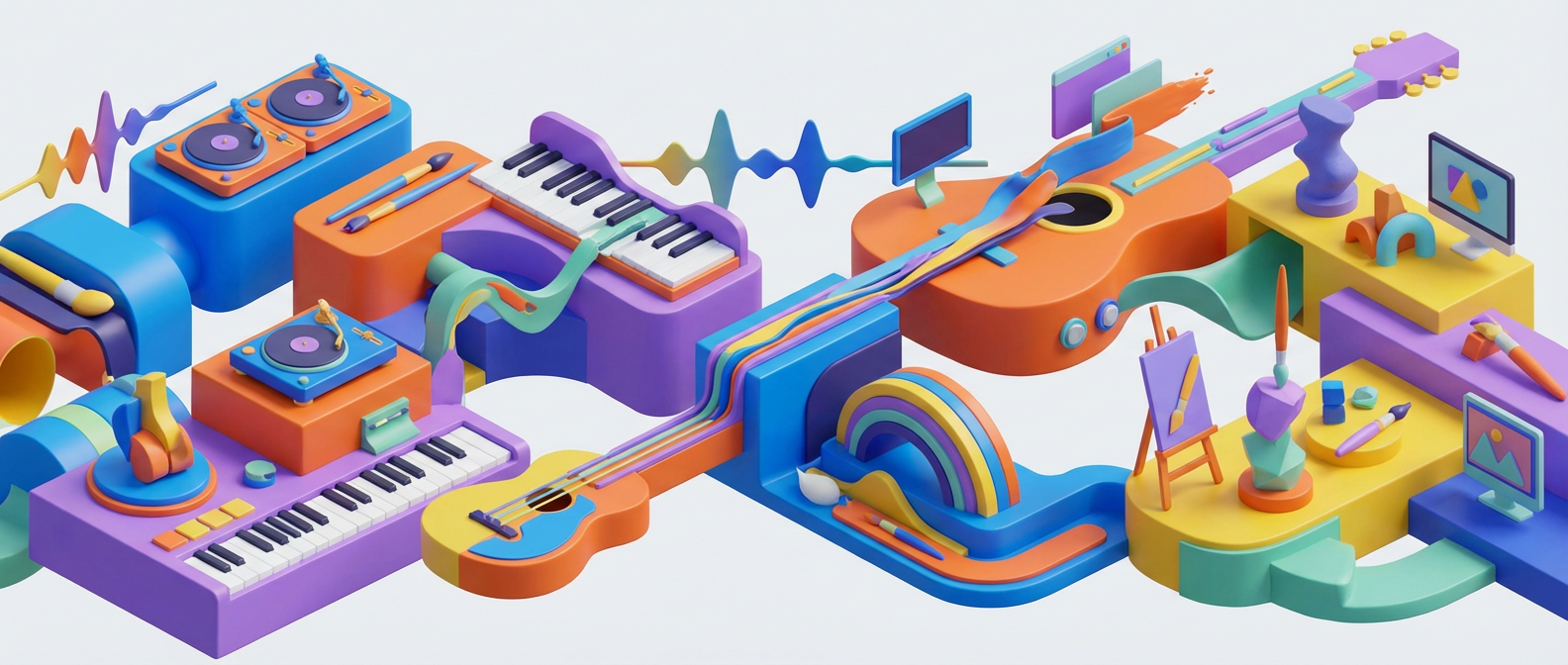
Visual art and music have been secret dance partners for centuries, sharing rhythm, harmony, and emotional language in ways that might surprise you. When we talk about the “rhythm” of brushstrokes or the “harmony” of colors, we’re not just using fancy metaphors. We’re recognizing something fundamental about how both art forms organize time, space, and feeling to move us.
Both arts work with tension and release, building anticipation and then satisfying it. Think about how a Bach fugue builds complexity layer by layer, then resolves into crystalline clarity. Now look at how Caravaggio uses light and shadow to guide your eye through a painting, creating visual crescendos that make your breath catch. Same principle, different medium.
When Abstract Art Found Its Beat
The early 1900s felt like a creative explosion waiting to happen. Jazz was emerging from New Orleans, bringing improvisation and bold new rhythms that broke every rule about “proper” music. At the exact same time, artists like Kandinsky, Mondrian, and Klee were throwing out realistic representation and diving headfirst into pure color, line, and form.
Kandinsky wrote extensively about painting’s relationship to music, calling his works “compositions” and “improvisations” just like musical pieces. His painting “Composition VII” doesn’t depict anything you’d recognize, but it pulses with the energy of a symphony orchestra hitting its climax. Those swirling forms and explosive colors create rhythm you can see. They build tension through overlapping shapes and release it through bursts of pure hue.
Mondrian took a different approach but reached for the same goal. His grid paintings with their precise black lines and primary color blocks weren’t cold geometry exercises. They were his attempt to capture the rhythm of modern life, the syncopated beat of city streets, the jazz age’s love of improvisation within structure. Look at “Broadway Boogie Woogie” and try not to hear piano keys dancing.
Paul Klee literally drew inspiration from music theory while teaching at the Bauhaus. He created works that followed musical principles of composition. His delicate watercolors move like chamber music, each color note carefully placed to create harmony or productive discord. You can almost hear the conversation between instruments in his geometric abstractions.
Color Theory Meets Sound Waves
Here’s where it gets really fascinating: both music and visual art use the same fundamental principles to create emotional impact. Musicians know that certain combinations of notes create tension while others feel resolved and peaceful. Visual artists discovered that colors work the same way.
Complementary colors like red and green create visual “dissonance” that grabs attention, just like certain musical intervals make your ear perk up. Analogous colors flow together like notes in a major scale, creating harmony that feels naturally pleasing. When Rothko layers those deep reds and oranges in his color field paintings, he’s essentially composing visual chords. They resonate in your chest the same way a pipe organ does.
Temperature plays a huge role too. Warm colors advance toward you with the boldness of brass instruments, while cool blues and greens recede like the gentle whisper of strings. Artists like Helen Frankenthaler poured diluted paint onto raw canvas, letting colors bleed and blend like watercolor jazz improvisations. The result? Visual melodies that seem to float and flow across the surface.
The Impressionists figured this out early. Monet’s haystacks series isn’t really about hay at all. It’s about how light changes throughout the day, creating different “moods” through color temperature shifts. Each painting captures a different time signature. You get the bright staccato of noon sun. Then the long, sustained notes of evening shadows. Same subject, completely different emotional register.
Rhythm You Can See
Rhythm isn’t just about music. Visual rhythm happens when artists repeat elements like color, shape, or line to create patterns your eye can follow. Jackson Pollock’s drip paintings are pure visual rhythm in action. Those sweeping arcs and splatters weren’t random chaos. They followed the rhythm of his body moving around the canvas, creating visual music you can trace with your finger.
Street art gets this instinctively. Walk through any city and you’ll see how muralists use repetitive patterns, flowing lines, and color transitions to create rhythm that matches the urban environment’s pulse. The best graffiti pieces flow like hip-hop beats, with bold primary statements punctuated by intricate detail work. Sometimes the rhythm is fast and aggressive. Sometimes it’s smooth and melodic. But it’s always there.
Even classical Renaissance masters understood visual rhythm. Look at Botticelli’s “Birth of Venus.” The flowing lines of Venus’s hair, the repetitive curves of the waves, the rhythmic placement of figures across the canvas create a visual tempo that guides your eye in a dance across the surface. It’s compositional music made visible. You can feel the steady beat underneath all those flowing curves.
The Modern Remix
Today’s artists continue this conversation between sound and sight in ways that would blow Kandinsky’s mind. Digital artists create visualizations that literally translate sound waves into moving color patterns. Musicians like Brian Eno create ambient soundscapes that work like audio paintings, building layers of texture and mood rather than traditional melodies.
Installation artists blur the boundaries completely. James Turrell’s light sculptures create immersive color experiences that feel like being inside a piece of music. His Skyspaces frame natural light changes throughout the day, creating slow-motion symphonies of shifting hue and intensity that change as you watch. I’ve sat in one for hours and felt like I was listening with my eyes.
Video artists combine both mediums directly, creating moving paintings set to carefully chosen soundscapes. The best ones don’t just add music to visuals or visuals to music. They create something entirely new where color, movement, and sound become inseparable elements of a single artistic statement.
Understanding these connections doesn’t require art school or music theory. It just takes paying attention to how different creative expressions make you feel. Next time you’re looking at a painting, ask yourself: what would this sound like? Or when you’re listening to music, close your eyes and notice what colors and shapes appear in your mind. You might be surprised by how much your senses already know about the secret conversations happening between the arts.