The Watercolor Starter Kit: Why Your First Brushes Matter More Than Your Last Masterpiece
The Paint Tube Paradox: Student Grade vs. Artist Quality
Here’s the thing about watercolor paint that nobody tells beginners: student-grade tubes aren’t just cheaper versions of artist-quality paint. They’re fundamentally different creatures. Student paint contains more filler, less pigment, and binders that behave like distant cousins of the real thing. It’s like comparing a photocopy of van Gogh’s “Starry Night” to standing in front of the actual canvas at MoMA.
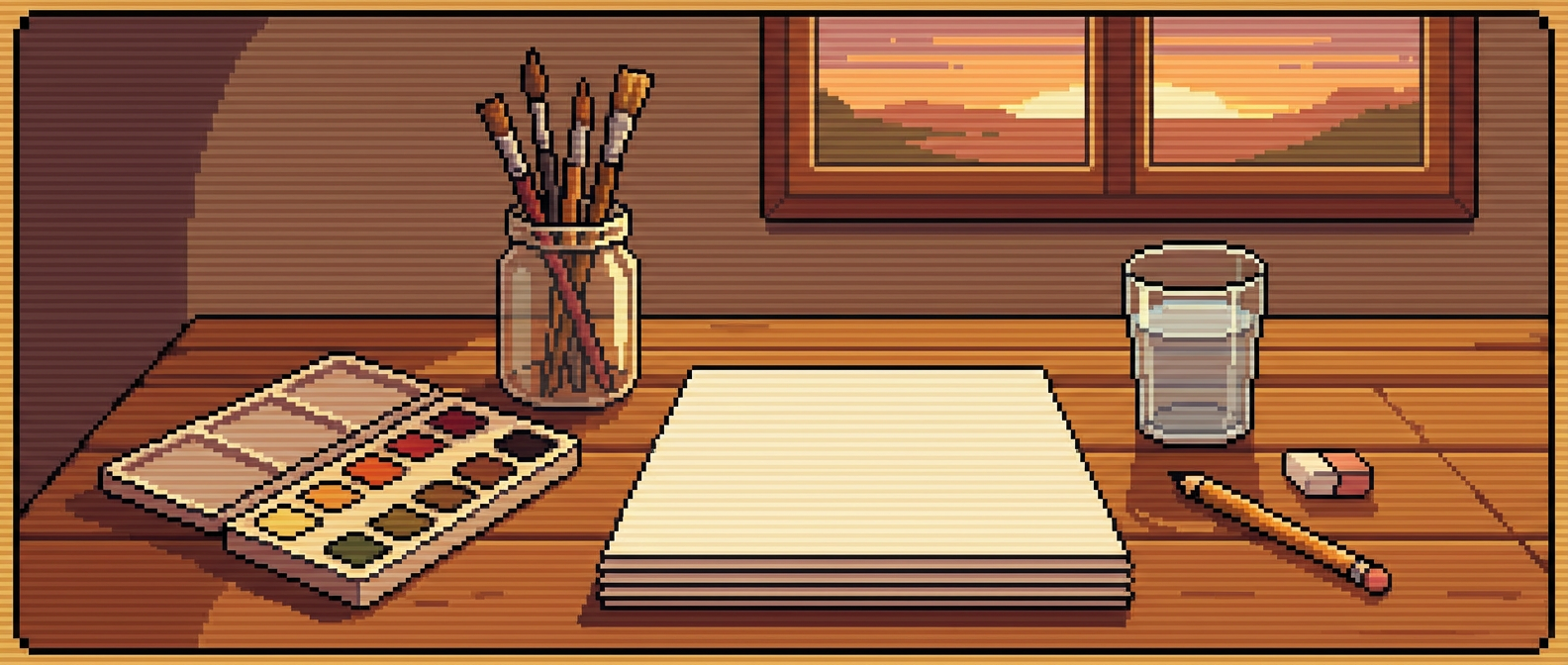
Artist-quality paints have pigment loads so dense they practically glow on the palette. When you squeeze out a ribbon of Winsor & Newton’s French Ultramarine, you’re getting the same basic formula that Cézanne might have recognized. The pigment particles suspend in water like tiny jewels, creating those luminous washes that make watercolor magical.
Start with a basic palette of six to eight artist-quality tubes: Cadmium Yellow Light, Cadmium Red Medium, Alizarin Crimson, French Ultramarine, Prussian Blue, Burnt Sienna, Raw Umber, and Payne’s Gray. This isn’t about snobbery, it’s about physics. Better pigments mean more predictable color mixing, and predictability builds confidence faster than any YouTube tutorial.

Brush Archaeology: Natural vs. Synthetic Bristles
The great brush debate mirrors every art material discussion since Renaissance workshops started mixing their own tempera. Natural hair brushes, particularly kolinsky sable, hold water like tiny reservoirs. Each hair has microscopic scales that grab and release water with surgical precision. Synthetic brushes, meanwhile, are engineered for consistency. Every bristle behaves exactly like its neighbors.
For beginners, this difference matters. A good kolinsky round brush can hold enough water for an entire wash while maintaining a needle-sharp point. It’s like having a fountain pen designed by nature. Synthetic brushes offer something different: reliability. They won’t surprise you with unexpected water dumps or mysterious stiffness after a few months of use.
The sweet spot for starting watercolorists? Mix both types. Get one excellent natural hair round brush in size 12 or 14, this will be your workhorse for washes and general painting. Add two synthetic rounds in sizes 6 and 2 for detail work. The natural brush teaches you how water wants to behave, while the synthetics give you control when you need precision.
Paper Politics: Hot Press, Cold Press, and the Texture Wars
Watercolor paper isn’t just a surface, it’s a collaborator. The paper’s texture, absorbency, and fiber content determine whether your paint sits on top like morning dew or sinks in like spilled coffee. Hot press paper feels smooth as silk under your brush, perfect for botanical illustrations or architectural studies where crisp lines matter. Cold press paper has more tooth, creating those happy accidents where pigment settles into tiny valleys, building texture you never planned.
Weight matters more than most beginners realize. Paper below 140lb will buckle when wet, turning your careful composition into a landscape of hills and valleys. Professional watercolorists often use 300lb paper, thick as cardboard and stubborn as a mule about staying flat. For beginners, 140lb cold press paper offers the best balance between workability and budget.
Cotton content separates the amateurs from the professionals. Papers made from cotton rag fibers can take incredible abuse: scrubbing, lifting, multiple washes, without falling apart. Student papers made from wood pulp are fine for practice, but they’ll teach you bad habits. They yellow over time and don’t forgive mistakes the way cotton papers do.
The Support System: Palettes, Water, and Workspace Wisdom
Your palette is where color theory becomes physical reality. Plastic palettes are convenient but they repel water, causing paint to bead up like raindrops on a windshield. Ceramic palettes, especially white ones, let you see your colors truthfully while providing enough friction to help mix pigments properly. Some artists swear by large dinner plates from thrift stores. The slightly rough surface of commercial ceramic grabs pigment just right.
Water quality affects everything. Hard water leaves mineral deposits that can muddy your colors. Soft water sometimes makes paint behave too freely. Most tap water works fine, but keep two containers: one for cleaning brushes, one for mixing clean colors. Change them often. Muddy water creates muddy paintings faster than any other beginner mistake.
Natural light remains the gold standard for color accuracy, but it’s not always available. If you’re painting at night or in a windowless room, invest in a daylight-balanced LED lamp. The color temperature should be around 5000K, cooler than most home lighting but warmer than fluorescent office fixtures. Your grandmother’s quilts probably look different under various light sources, and your paintings will too.
Beyond the Basics: Tools That Bridge Technique and Vision
Masking fluid opens possibilities that pure brush technique can’t match. It’s liquid rubber that preserves white paper while you paint around it. Think of it as temporary armor for highlights. Natural sponges create textures that brushes struggle with, perfect for suggesting foliage or rock surfaces. Paper towels aren’t just for cleanup; they lift wet paint to create clouds, soften edges, or suggest light breaking through trees.
Spray bottles let you control moisture after the fact, extending working time or creating atmospheric effects. A hair dryer speeds drying between layers, though it can also create unwanted textures if used carelessly. Salt dropped into wet paint creates crystalline patterns that suggest everything from snow to distant galaxies, depending on your imagination.
The most important tool remains your willingness to experiment. Watercolor rewards curiosity more than caution. Every material choice, from paper texture to brush size, creates different possibilities. Start with quality basics, then let your paintings tell you what they need next. The best art supplies are the ones that disappear into your process, becoming extensions of your vision rather than obstacles to overcome.