Hidden in Plain Sight: The Women Artists History Almost Erased
When Masters Were Mistresses: The Great Misattribution Game
You know that gorgeous still life hanging in the Met’s European paintings gallery? The one with pears so realistic you want to reach out and test their ripeness? For decades, visitors admired it as the work of a Dutch master. Plot twist: it was painted by Rachel Ruysch, who commanded higher prices than Rembrandt during her lifetime. Yet somehow, her signature got overlooked, her work attributed to male contemporaries, her genius quietly shuffled into storage rooms.
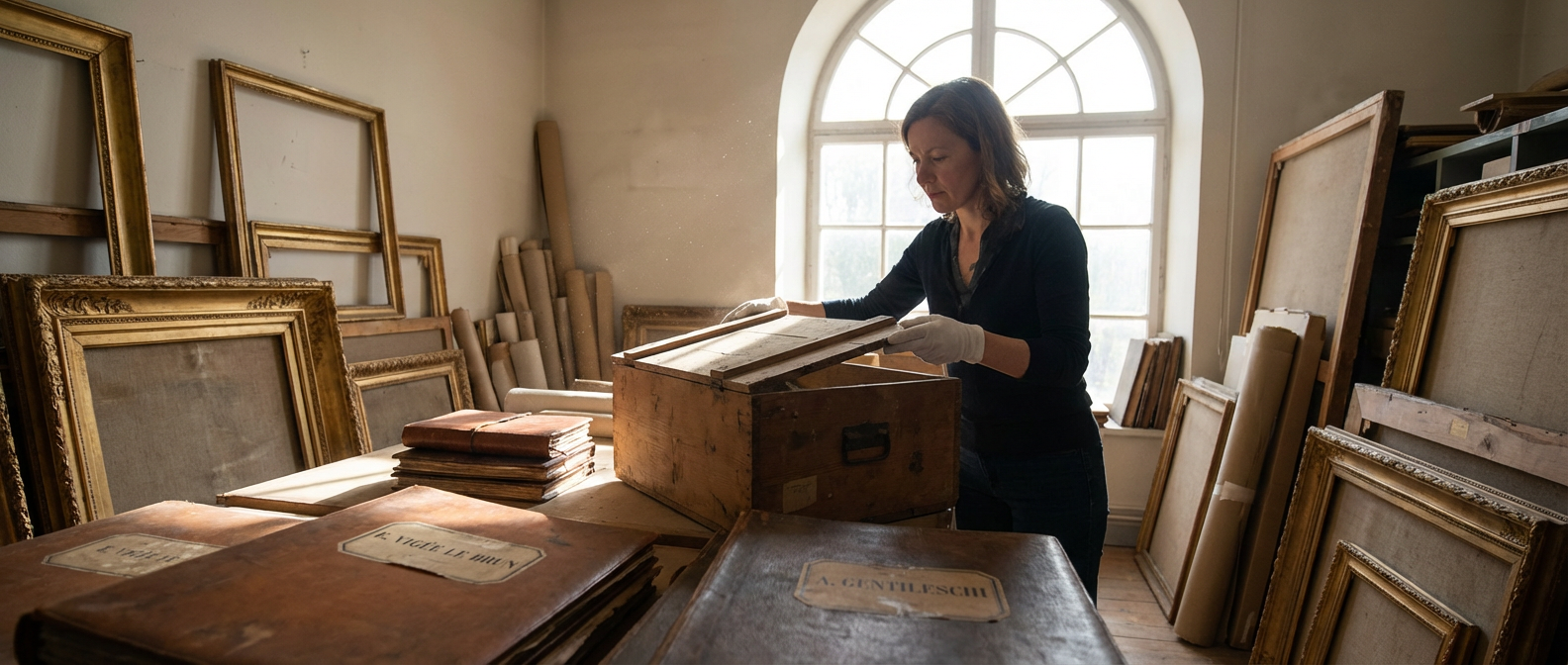
This pattern repeats across centuries like a broken record. Artemisia Gentileschi’s dramatic chiaroscuro was dismissed as derivative of Caravaggio, even though she developed her own revolutionary approach to light that made Caravaggio’s shadows look timid. Her “Judith Slaying Holofernes” doesn’t just use darkness as atmosphere, it weaponizes it, turning shadow into psychological warfare. Compare that to Caravaggio’s version, where drama works for beauty. Artemisia’s version works for justice.
The misattribution machine worked like clockwork. Women’s paintings were reattributed to their fathers, husbands, or male students. Their innovations became footnotes to masculine genius. But here’s what makes me furious and fascinated in equal measure: many of these women weren’t just painting, they were solving artistic problems their male peers couldn’t crack.

The Technical Revolutionaries: Beyond Pretty Pictures
Let’s talk about Rosalba Carriera, the Venetian who basically invented modern portrait painting. While her contemporaries were still wrestling with oil’s slow-drying limitations, Carriera perfected pastel techniques that captured psychological intimacy oil couldn’t touch. Her portraits reveal interior lives with a directness that makes Gainsborough look like he’s painting through gauze.
Then there’s Elisabetta Sirani, who painted over 200 documented works before dying at 27. Her brushwork moved faster than her male contemporaries because she developed a wet-on-wet technique that kept oils workable longer. Look at her “Portia Wounding Her Thigh,” the flesh tones blend with a fluidity that wouldn’t be seen again until Rubens, except Sirani got there first. She was running a painting workshop, teaching male students, and out-producing established masters by age 20.
The technical innovations weren’t accidents. These women faced unique constraints that forced creative solutions. Denied access to life drawing classes, they became masters of portraiture and still life. Excluded from large public commissions, they perfected intimate scales that influenced domestic space design. Their limitations became their innovations, their restrictions their revolutionary edge.
The Pattern Recognition Problem: Why We Keep Missing Them
Here’s where art history gets weird. We’ve trained ourselves to recognize genius through masculine patterns. Bold brushstrokes equal confidence. Large scale equals ambition. Religious or historical subjects equal importance. But what if genius looked different? What if it appeared in the precise observation of daily life, in the psychological penetration of portraiture, in the technical mastery of challenging materials?
Consider Judith Leyster’s “The Happy Couple.” At first glance, it’s a charming domestic scene. Look closer. She’s using light sources that create competing focal points, destabilizing the viewer’s attention in ways that predict modern cinematic techniques. Her couples aren’t just happy, they’re psychologically complex, caught between public performance and private truth. Frans Hals painted movement. Leyster painted the moment before movement, the psychological tension that generates action.
We missed these innovations because they didn’t fit our templates for revolutionary art. Women artists weren’t painting manifestos. They were painting investigations, into light, psychology, materiality, domestic space. Their revolutions were quieter but no less radical. They changed how we see rather than what we see.
The Ripple Effects: Tracing Hidden Influences
The influence networks tell incredible stories once you start mapping them. Marie Bashkirtseff’s plein air techniques influenced the Impressionists before she died at 25. Her journal entries describe color theory experiments that Monet would later popularize. But because she was Russian, female, and died young, her contributions became invisible threads in art history’s fabric.
Anna Ancher developed approaches to natural light that transformed Scandinavian painting. Her interiors glow with a quality that makes Hammershøi’s famous rooms look somber by comparison. She painted light as presence rather than absence, warmth rather than drama. The Danish Golden Age painters who followed built on foundations she established, but her name rarely appears in their origin stories.
The pattern extends beyond individual influence to entire movements. The Pre-Raphaelite Brotherhood included women whose botanical accuracy and symbolic innovation defined the movement’s visual language, but histories focus on the male founders. These women weren’t muses or models, they were co-conspirators, developing the movement’s most distinctive characteristics while their male colleagues got the manifestos and museum exhibitions.
Excavation and Recognition: The Ongoing Discovery
The exciting news? We’re living through the greatest art historical excavation project ever undertaken. Museums are pulling works from storage, reattributing paintings, discovering signatures hidden under centuries of grime. The Guerrilla Girls started asking “Do women have to be naked to get into the Met Museum?” in 1985. Today, major museums are actively rewriting their collection narratives.
Recent scholarship has identified over 60 previously unknown works by Artemisia Gentileschi. Clara Peeters’ innovative still lifes are finally getting major exhibitions. Hilma af Klint’s abstract paintings, created years before Kandinsky’s supposed invention of abstraction, are reshaping our understanding of modern art’s origins. Each rediscovery forces us to question what else we’ve overlooked.
But here’s what fascinates me most: these aren’t just corrective additions to art history. They’re fundamental revisions that change how we understand artistic development, influence patterns, and the nature of innovation itself. When we restore women artists to their proper places, we don’t just get more names, we get different stories about how art evolves, spreads, and transforms culture.
The next time you’re in a museum, try this experiment: look for the paintings that seem to predict later developments, that solve problems in unexpected ways, that reveal psychological depths their contemporaries missed. Check the attribution. You might be looking at a work by an artist whose genius we’re only beginning to understand. What other revolutions are hiding in plain sight, waiting for us to recognize the patterns we’ve been trained to overlook?