Ancient Hands, Modern Clay: How 5,000-Year-Old Techniques Are Shaping Today’s Ceramic Revolution
The Wheel Keeps Turning
Walk into any ceramic studio today and you’ll see something that kind of blows my mind. Artists hunched over pottery wheels are using movements that were perfected in Mesopotamia around 3500 BCE. Their hands move with the same intuitive push-pull rhythm that shaped vessels in ancient Sumer, yet the results are completely modern.
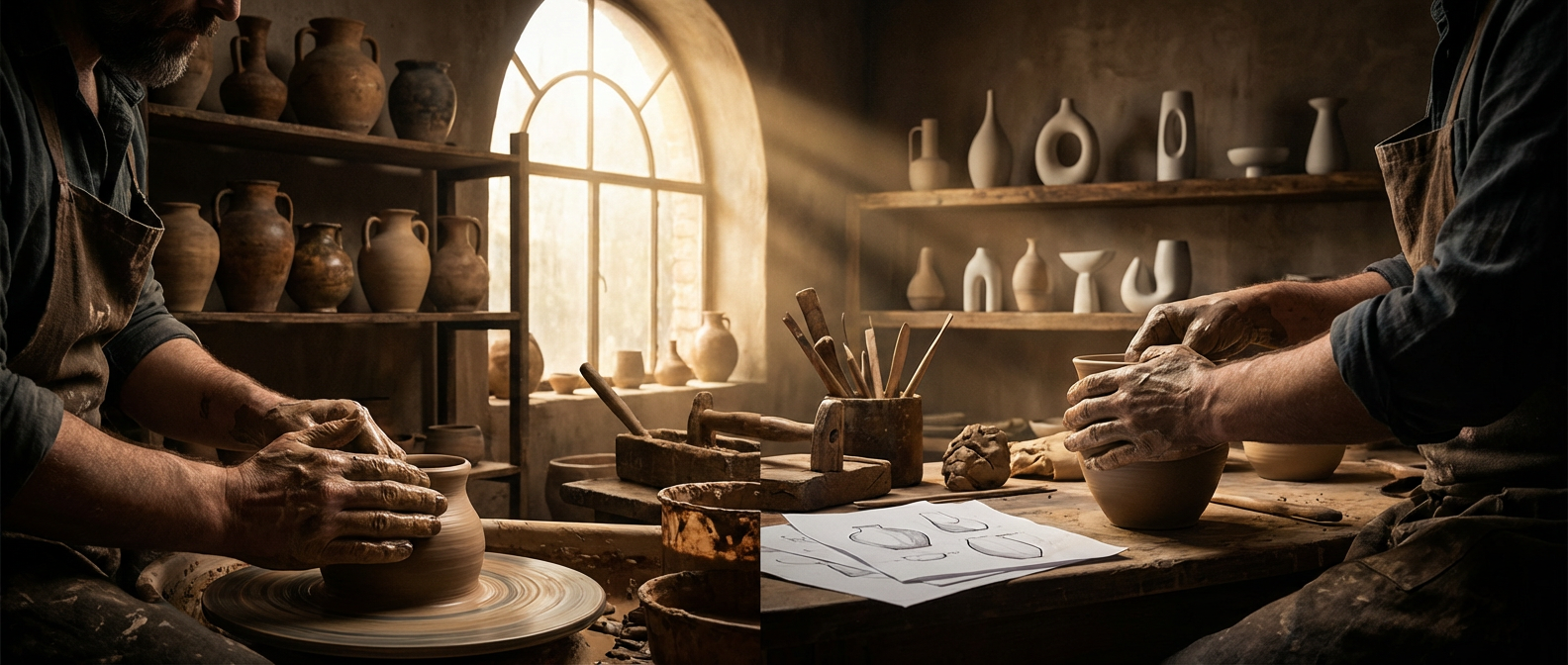
At Brooklyn’s Turning Earth ceramics studio, I watched Sarah Chen coil thick ropes of stoneware clay into a towering vessel. She wasn’t following a YouTube tutorial or modern manual. Her technique was identical to what potters did in Japan’s Jomon period 14,000 years ago. The difference? Chen’s finished piece will house succulent gardens for Manhattan apartments, not store rice for winter survival.
This isn’t just nostalgic craft revival. Contemporary ceramicists are going back to ancient techniques because they solve real problems. Hand-building methods create textures that industrial processes can’t touch. Pit-firing produces those smoky, unpredictable surfaces that feel authentic when everything else looks mass-produced. These artists aren’t copying the past. They’re arguing with it, building on it.

Fire Stories Written in Smoke and Ash
The most dramatic revival happening right now involves ancient firing techniques. Pit firing, saggar firing, and raku burning are producing surfaces that look like abstract paintings. At the recent American Craft Council show in Baltimore, nearly half the ceramic artists displayed work fired using pre-industrial methods.
Raku firing, originally developed for Japanese tea ceremonies in the 16th century, creates those metallic and crackled effects you see everywhere now. The process is pretty intense: you heat pottery to 1800°F, then pull the glowing pieces from the kiln with metal tongs and place them in containers filled with combustible materials. The flames and smoke create patterns you can’t control or repeat exactly.
California artist Maria Martinez’s great-granddaughter, Barbara Gonzales, still uses the burnished blackware technique her ancestor perfected at San Ildefonso Pueblo in the early 1900s. But Gonzales shapes her vessels into contemporary forms that speak to climate change and water scarcity. The ancient terra sigillata burnishing technique creates surfaces so reflective they seem to hold light itself.
These firing methods produce what ceramicist Peter Voulkos called “controlled accidents.” The artist sets up conditions, then fire and chemistry take over. When algorithms predict everything else in our lives, this surrender to unpredictability feels radical.
The Language of Clay Memory
Clay remembers everything. Every touch, every tool mark, every temperature change gets recorded in its molecular structure. Ancient potters understood this relationship. They developed techniques that worked with clay’s memory rather than fighting it.
Korean moon jars demonstrate this perfectly. Created during the Joseon Dynasty using simple wheel-throwing and joining techniques, these white porcelain vessels achieved an irregular, breathing quality that feels alive. Contemporary artist Edmund de Waal has spent decades studying these forms, incorporating their asymmetrical perfection into installations for major museums worldwide.
The ancient technique of burnishing clay with smooth stones before firing creates surfaces that rival polished metal. Native American potters like Lucy Lewis from Acoma Pueblo maintained these methods through centuries of cultural pressure. Now ceramicists globally are rediscovering burnishing to create the matte, stone-like finishes that define contemporary minimalist pottery.
Slip trailing, where liquid clay gets squeezed through hollow reeds to create surface decoration, started in medieval England. Today’s ceramicists use the same basic tools but create abstract gestural marks that could hang in any contemporary gallery. The technique hasn’t changed, but the visual language has completely evolved.
Tools That Bridge Millennia
Some ceramic tools haven’t been improved in thousands of years. Wooden ribs cut from bamboo still create the smoothest curves on wheel-thrown pottery. Dried gourds make perfect scrapers. Sharp shells cut clean lines through leather-hard clay.
At Anderson Ranch Arts Center in Colorado, master potter Michael Sherrill teaches students to make their own tools from found materials, just as potters did before ceramic supply catalogs existed. Students carve ribs from scrap wood, make brushes from animal hair, and create stamps from carved bisque clay.
The paddle-and-anvil technique produces forms impossible to achieve on a wheel. You hold a smooth stone inside while tapping the exterior with a wooden paddle. This method, documented in virtually every pottery-making culture, creates the slightly irregular walls that give handmade ceramics their character.
Japanese hake brushes, made from soft goat hair bound with hemp, still create the most fluid glaze applications. Chinese bamboo calipers measure proportions with the same precision they did during the Tang Dynasty. These tools work because they were refined through centuries of daily use by working potters.
Living Traditions in Studio Practice
The most exciting ceramic work today doesn’t just borrow ancient techniques. It transforms them. At Archie Bray Foundation in Montana, resident artists regularly experiment with Anagama kiln firing, a Japanese method that takes days to complete and produces surfaces marked by natural ash deposits.
British ceramicist Grayson Perry builds massive coil pots using techniques unchanged since the Neolithic period, then decorates them with contemporary imagery that addresses gender, class, and politics. His ancient building methods provide the slow, meditative process needed to develop his complex narrative surfaces.
Indigenous potters like Tammy Garcia from Santa Clara Pueblo continue traditional techniques while addressing contemporary themes. Her carved blackware vessels use ancestral methods to create forms that speak to modern Native American experiences.
These artists prove that ancient techniques aren’t limitations. They’re launching points for innovation. When contemporary ceramicists master traditional methods, they gain access to effects and possibilities that modern technology simply cannot reproduce.
Next time you hold a handmade ceramic piece, run your fingers across its surface. Feel for the slight irregularities that reveal human touch, the subtle marks that connect this object to thousands of years of pottery tradition. Notice how ancient wisdom lives in these contemporary forms, proof that some technologies are so perfectly evolved they need no improvement, only fresh interpretation.