Inside the Getty’s Vermeer Revolution: How Multispectral Imaging is Rewriting 17th-Century Light
The Layers Beneath the Light
Here’s what stopped me in my tracks last month: the Getty Conservation Institute discovered three distinct underpaint layers in Vermeer’s “Girl with a Pearl Earring” that conventional X-ray technology had completely missed. Three. Hidden beneath that luminous surface we’ve all memorized. This wasn’t some minor technical adjustment or a footnote in conservation literature. This fundamentally changes how we understand what Vermeer was thinking when he picked up his brush.

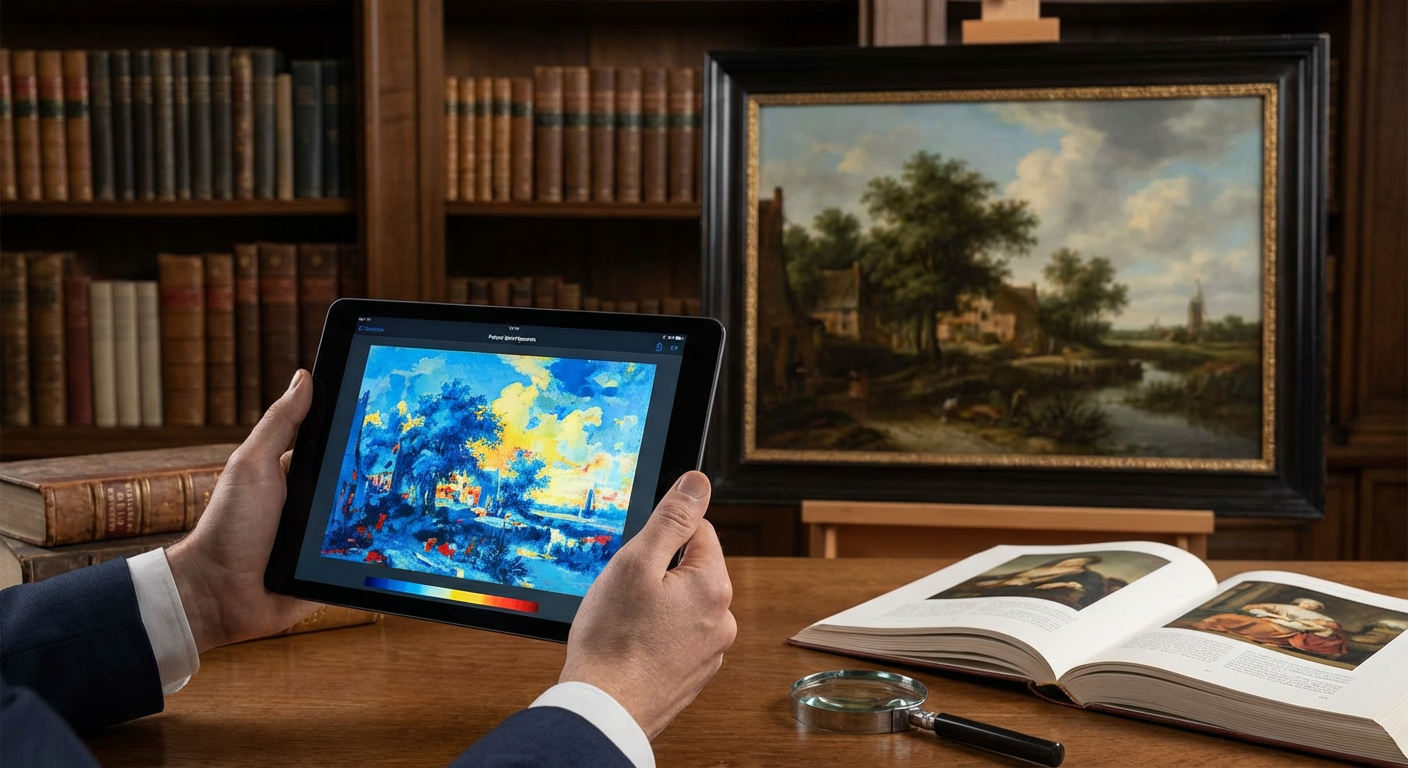
I spent hours staring at the multispectral imaging data they released, and honestly, it felt like watching an artist think in real time. Those underpaint layers aren’t mistakes or abandoned ideas. They’re evidence of deliberate compositional strategy. Vermeer was mapping light with the precision of an architect. He was building the glow, layer by layer, the same way you’d layer glazes in watercolor or build depth in a relief print.
The technical breakthrough here matters because it exposes a gap in how we’ve been reading these paintings for centuries. We’ve treated the final surface as the whole story, when in fact it was the culmination of a sophisticated optical conversation happening beneath the paint itself. The Getty’s team used multispectral imaging to see past what our eyes can detect, revealing the hidden architecture of Vermeer’s process.
The Camera Obscura Question (And Why It’s Suddenly Urgent)
For decades, art historians debated whether Vermeer used a camera obscura. Some dismissed it as conspiracy theory. Others whispered it as a guilty secret. But 2025 computational modeling from the Heritage Science journal changed the conversation entirely. The numbers don’t lie anymore. The optical precision, the perspective distortions, the way light pools in specific corners of his compositions—it all maps onto camera obscura projection with eerie accuracy.
What’s fascinating is that confirming this doesn’t diminish Vermeer. It reframes him. He wasn’t a supernatural genius who painted light through mystical intuition. He was a craftsman who understood technology, who weaponized it, who then transformed it into something transcendent. That’s actually more interesting to me than the alternative. It’s the difference between appreciating a violinist’s raw talent and understanding that she also studied for twenty years and knows acoustics on a molecular level.
Think about how Renaissance artists embraced linear perspective once they had the tools to understand it geometrically. Vermeer did something similar with optical projection. He didn’t hide behind the technology. He used it as a foundation and then painted over it, layer by layer, until it became something the technology alone could never create. That’s mastery. That’s the real story.
What the Data Revolution Looks Like
The Getty Conservation Institute Research team launched an open-access database in late 2024 containing over 12,000 high-resolution pigment maps from Dutch Golden Age paintings. Let that sink in. Twelve thousand. You can now zoom into the granular structure of paint in works you’ve only seen in person or in fuzzy art history slides.
This shifts the entire conversation about how we study art. We’re moving away from the connoisseur model where expertise meant accumulating subjective impressions over decades. Now expertise means understanding how to read data. Pigment composition tells you about supply chains, geographical sourcing, even which workshops had connections to specific material suppliers. It tells you about cost and value and what artists prioritized when commissioning their materials.
Researchers at the University of Amsterdam identified a specific lead white compound in Vermeer’s works that connects to a single Amsterdam supplier documented in 17th-century guild records. This isn’t trivial detail work. It’s detective work that places Vermeer’s studio within a precise economic and social network. It’s how we move from treating artists as floating above their historical moment to understanding them as people embedded in systems of production and commerce.
The Audience Transformation
The Mauritshuis Museum in The Hague reported over 650,000 visitors in 2024 after expanding its Vermeer digital interpretation gallery. That’s a 40 percent increase from previous years. People are hungry for this. They want to understand the process, not just experience the product. They want to know about the layers and the light and the optical mathematics hidden beneath the surface.
What’s happening at Mauritshuis mirrors something broader in how we engage with art now. We don’t want passive consumption anymore. We want narrative. We want to understand the artist’s choices and the technical constraints they worked within. Digital galleries that show pigment analysis and reconstruction imaging alongside the actual painting give us that narrative access.
This is what happened to classical music when we started getting behind-the-scenes documentary footage. It didn’t diminish the experience of listening to a symphony. It enhanced it. Knowing how an orchestra works, seeing conductors rehearse, understanding the physics of different instruments—all of that deepens your appreciation when you hear the final performance. The same applies to visual art now. Understanding Vermeer’s technique makes standing in front of the actual painting a richer experience.
What This Means for How We Look Now
The Getty’s 2025 Vermeer reconstruction project isn’t just archival work or academic exercise. It’s fundamentally changing what we pay attention to when we look at a painting. Once you know about those hidden underpaint layers, you start questioning every surface. You wonder what’s beneath other works you thought you fully understood. You begin to see paintings as palimpsests, as conversations between the artist’s hand across time.
This matters because it shifts the entire premise of art appreciation. We’ve been trained to look for the finished gesture, the final statement. But the real complexity lives in the decision-making process. It lives in those layers we can’t see and the technology that’s allowing us to finally peek underneath. Vermeer becomes less a distant master and more a collaborator in his own revelation, his work finally being understood centuries after he painted it.
Have you had a moment where learning about technique completely changed how you see a work? Where suddenly the brushstroke or the composition or the color choice became legible in a new way? I’d love to hear about it. Share your experience in the comments, or reach out if you want to go deeper on any of this.